


If you’re wondering what happens in ERP therapy, exposure and response prevention (ERP) commonly involves an assessment, shared goals, a gradual exposure plan, guided practice and progress reviews.
During exposure practice, you approach agreed triggers, thoughts, situations or uncertainty while reducing compulsive responses, including mental compulsions. Between-session practice is planned with your therapist.
ERP Therapy at a Glance
Many people considering ERP worry that they will be pushed into frightening situations before they feel ready. ERP should involve informed consent and collaborative planning, rather than forcing someone into feared situations.
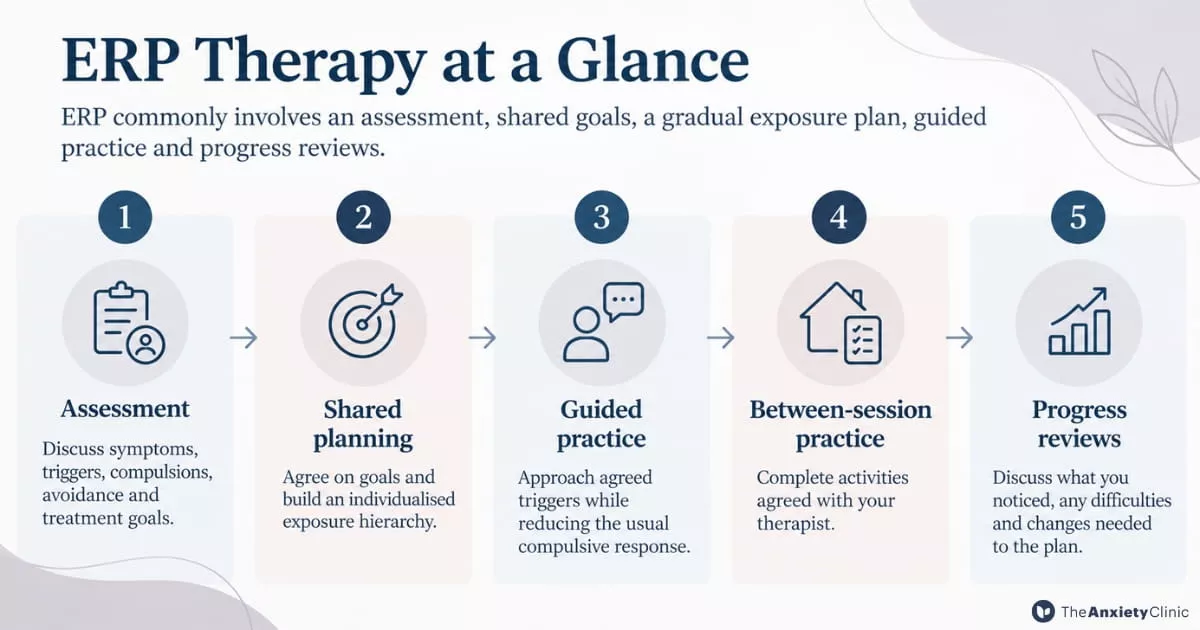
ERP is an evidence-based therapy commonly used for obsessive-compulsive disorder (OCD). It is often delivered within cognitive behavioural therapy (CBT), with activities adapted to the person’s needs rather than following one standard programme.
Exposure and Response Prevention in Plain English
Exposure and response prevention (ERP) is a structured behavioural therapy commonly used for obsessive-compulsive disorder (OCD).
Exposure involves gradually approaching agreed situations, thoughts, images, triggers or uncertainty rather than consistently avoiding them.
Response prevention involves reducing the compulsions used to manage distress or seek certainty. These can include visible rituals as well as rumination, mental reviewing, internal reassurance and attempts to suppress intrusive thoughts.
The aim is not to prove that a feared outcome is impossible or eliminate every intrusive thought. Instead, ERP can help a person practise responding differently to distress and uncertainty without automatically completing a compulsion.
Why Anxiety Is Part of ERP Practice
Anxiety can be an expected part of approaching something a person has previously avoided. Feeling anxious does not automatically mean therapy is unsafe or failing, although significant concerns should be discussed with the treating clinician.
ERP should involve informed consent and collaborative goal-setting. A person should not be forced into feared situations. They can raise concerns and discuss changes with their therapist.
What Happens Before ERP Therapy Starts
ERP commonly begins with a clinical assessment by a suitably qualified professional, such as a clinical psychologist or registered psychologist.
The clinician may ask about symptoms, triggers, avoidance, compulsions, daily functioning, treatment goals and relevant mental health history. This helps inform whether ERP may be appropriate and how therapy could be adapted to the person’s needs and circumstances.
Assessment is individualised because similar-looking behaviours can serve different purposes. The clinician considers the person’s presentation rather than applying the same treatment plan to everyone.
Online information cannot determine whether someone has OCD. If you are exploring possible symptoms, you can start by understanding OCD thoughts and compulsions, then discuss your concerns with an AHPRA-registered clinician.
Setting Shared Goals and Building an Exposure Plan

The therapist and client identify what OCD may be disrupting and what the person wants to regain. Goals might include spending more time with others, focusing at work or study, completing everyday activities, or making decisions with less checking.
They may then create an exposure hierarchy, which is an individualised list of practice situations arranged from more manageable to more difficult. The order and pace can be adjusted as treatment progresses.
ERP is not a test of bravery or endurance. The plan should reflect the person’s goals, circumstances and agreed treatment approach.
What Happens During an ERP Therapy Session
ERP sessions can vary, but a therapist may begin by checking in and reviewing recent between-session practice. You may then agree on a target for the session and complete guided behavioural practice where appropriate.
During exposure work, the therapist can help you notice anxiety and the urge to neutralise it without automatically performing the usual compulsion. Discussion and observation may also help identify less visible responses that were difficult to recognise before.
The session is not simply about making anxiety disappear. You may review how you responded, whether compulsions were reduced and what could be adjusted next.
Exposure Is Planned, Gradual, and Consensual
Graded ERP involves planned exposure that progresses according to the person’s circumstances and treatment plan. This differs from flooding, which involves starting with highly distressing exposure.
Overwhelming exposure is not assumed necessary for every person. You can ask questions or discuss changes to the task or pace with your therapist.
Response Prevention Includes Mental Compulsions
Compulsions can include visible behaviours such as checking, washing, arranging or reassurance seeking, although these do not occur for everyone.
They can also be less visible. Mental compulsions may include repeatedly reviewing an event, replacing an unwanted thought, giving yourself internal reassurance or analysing doubt in search of complete certainty.
These responses may require discussion with a therapist to identify. Response prevention can involve practising a different response rather than automatically carrying out the usual compulsion.
A Non-Graphic Example of the ERP Process
Consider a fictional client who repeatedly checks something because they fear they may have made a mistake.
During a therapist-guided ERP exercise, the client might:
- Approach the agreed trigger: Discuss or encounter the situation linked to the fear.
- Notice the urge to check: Recognise anxiety and the urge to seek certainty.
- Practise response prevention: With the therapist’s guidance, practise not completing the agreed checking or reassurance response.
- Review the experience: Discuss what the client noticed and what could inform future practice.
This example is illustrative only. ERP activities are planned with a qualified therapist and should reflect the person’s assessment, goals and circumstances.
What the Person May Learn Over Time
Planned practice may help a person notice changes in distress without relying on a compulsion.
They may also become more able to tolerate uncertainty and recognise urges to check, ruminate or seek reassurance.
The learning differs between people. ERP does not guarantee that anxiety will disappear or that intrusive thoughts will stop occurring.
Between-Session Practice and Progress Reviews
ERP does not only happen during appointments. Your therapist may agree on activities to practise between sessions.
These activities should fit the treatment plan and your circumstances. They may involve approaching agreed situations while reducing compulsive responses.
At the next appointment, you can discuss difficulties, compulsive urges and anything that made practice harder.
Progress reviews can also look beyond anxiety levels. Your therapist may consider changes in compulsions, avoidance, daily functioning and progress towards your treatment goals.
When ERP Feels Exhausting or Difficult
ERP can feel demanding because it involves changing familiar responses to distress and uncertainty.
If a practice task feels too difficult, causes significant distress or becomes hard to manage, discuss it with your therapist. The plan and pace can then be reviewed together.
You do not need to push through concerns alone. ERP should remain collaborative.
How Long ERP Takes and Whether It Works
There is no fixed number of ERP sessions that suits everyone. Treatment length can vary based on symptoms, goals, treatment needs and personal circumstances.
Changes and progress can vary across people and areas of OCD.
ERP is widely used as an evidence-based psychological treatment for OCD. Your therapist can discuss what the evidence means for your circumstances and review whether the treatment plan remains suitable.
Treatment should not be framed around guaranteed results or symptom elimination. Progress is reviewed throughout therapy.
When to Seek Individual Clinical Advice
Online information cannot assess your symptoms or determine whether ERP is suitable for you.
A qualified mental health professional can discuss your symptoms, treatment options and any concerns about ERP. If you have immediate concerns about your safety, seek urgent support through appropriate local health services.
Questions to Ask an ERP Therapist Before Starting
Choose a therapist whose approach fits your needs.
Before starting ERP, you may want to ask about their experience with OCD and exposure and response prevention. You can also ask how they assess your symptoms and involve you in treatment planning.
Useful questions include:
- How will we decide which exposures are appropriate for me?
- What happens if a practice task feels too difficult?
- How do you work with mental compulsions?
- How will we know whether the treatment plan needs to change?
- What kind of between-session practice might be involved?
- How will we review progress during treatment?
You can also ask about the therapist’s professional registration and clinical experience. If you are receiving other mental health care, ask how different treatments or providers may be considered together.
Finding Informed OCD Support in Sydney
If you are considering ERP in Sydney, look for a qualified mental health professional with relevant OCD experience.
You can ask whether the clinician is registered with AHPRA and has training or experience in ERP. It is also worth discussing whether their approach suits your symptoms, goals and circumstances.
The Anxiety Clinic is a clinical psychology practice in Bondi Junction, Sydney. It supports children, adolescents and adults with anxiety and related mental health concerns, including OCD.
If you are considering care through the clinic, you can read more about its OCD therapy in Sydney or make an appointment enquiry.
Current ERP provision and clinician availability should be confirmed with the clinic before making a decision.
FAQs
What happens in an ERP therapy session?
An ERP session may include a check-in, review of recent practice, guided exposure and discussion. The therapist helps you approach agreed triggers while reducing compulsive responses.
Will I be forced to do an exposure?
No. ERP should involve informed consent and collaborative planning. You can discuss concerns about an exposure, including its difficulty and pace, with your therapist.
Does ERP address mental compulsions?
Yes. ERP can address less visible compulsions such as rumination, mental reviewing and internal reassurance. These responses can be discussed with your therapist and included in treatment planning.
What happens between ERP appointments?
Your therapist may agree on activities to practise between appointments. These activities should fit your treatment plan and circumstances, then be reviewed during later sessions.
How long does ERP therapy take?
There is no fixed treatment length for everyone. The timeframe can vary based on symptoms, goals, treatment needs and personal circumstances.
Key Takeaway
Understanding what happens in ERP therapy can make the process clearer before treatment begins. ERP is a collaborative process that involves approaching agreed triggers, thoughts, situations or uncertainty while reducing compulsive responses.
Treatment may involve assessment, shared planning, gradual exposure, guided practice, between-session activities and progress reviews.
The approach should be individualised and based on informed consent. A qualified mental health professional can help determine whether ERP is suitable for your circumstances and how the treatment plan should be adjusted over time.