


Obsessive-compulsive disorder (OCD) is a mental health condition that involves recurring obsessive thoughts and compulsive behaviours. The different types of OCD can look very different from one person to the next.
That’s why contamination, harm and relationship OCD are better seen as common themes than separate disorders. This guide covers those themes and how they’re treated.
How Many OCD Types Are There?
There is no fixed number of OCD types. OCD is one disorder.
The Diagnostic and Statistical Manual of Mental Disorders (DSM-5-TR) groups it with obsessive-compulsive and related disorders. Its symptom patterns are often described as themes or subtypes.
Researchers often group symptoms into broad themes. The labels and groupings vary. Commonly described themes include:
- Contamination
- Harm
- Symmetry, order or exactness
- Unwanted taboo thoughts, such as sexual or religious ones
People also talk a lot about narrower themes, such as relationship OCD and scrupulosity. Before we dive deeper into the types, let’s discuss what OCD really is.
What Is Obsessive-Compulsive Disorder (OCD)?
As mentioned earlier, OCD is a cycle of obsessions and compulsions. Obsessions are unwanted, repetitive thoughts, images, urges or doubts that cause significant distress.
Compulsions come next. These are the repetitive behaviours or mental acts a person feels driven to do to ease that distress. Some are mental, such as reviewing events or counting.
This is more than liking things tidy or having a compulsive habit. OCD is also different from obsessive-compulsive personality disorder, which is about rigid control and perfection.
OCD can affect both children and adults. Healthdirect explains that 500,000 people in Australia are affected by OCD, starting in late childhood.
Most people have intrusive thoughts now and then. What sets OCD apart is the pattern: obsessions, compulsions or both that cause distress, take up time or affect daily life.
To tell the difference, a psychologist or mental health professional can assess your symptoms. They can rule out related conditions, such as depression or anxiety disorders, and say whether you meet the criteria for OCD. If necessary, a physical exam may also help rule out other causes.
What Are the Different Types of OCD?
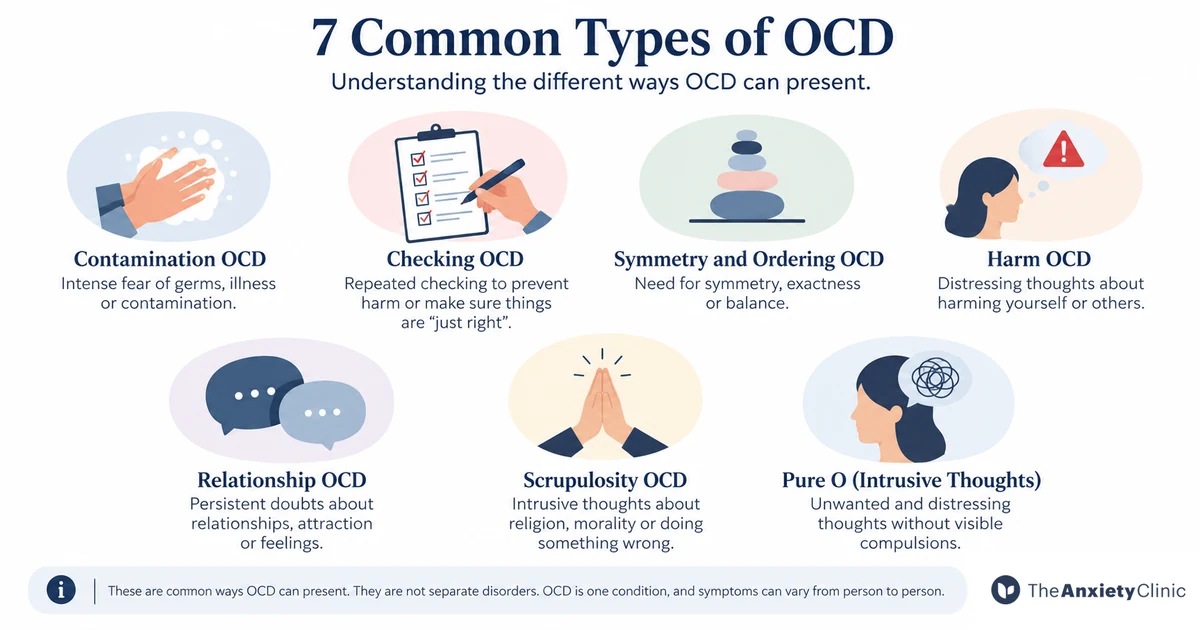
Contamination OCD
Contamination OCD is driven by fears related to germs, illness, dirt, or body fluids. Someone might worry about becoming ill after touching objects others have touched. They may then wash or clean excessively or avoid situations like shaking hands.
Checking and Responsibility OCD
With this theme, a person has persistent doubt. They wonder if something was done properly. Or they wonder if they could be responsible for something bad happening.
They might doubt that the door is locked or the stove is off. They might keep checking taps and light switches over and over.
Other compulsions include mentally reviewing events and asking others for reassurance again and again.
Symmetry or "Just Right" OCD
Some people feel intense stress when objects aren’t lined up or don’t face a certain way. Symmetry, also known as “just right” OCD, involves a need for order or exactness. It can also be a feeling that something isn’t right.
To ease that stress, a person might arrange items until they feel right. They might repeat actions. They might also count things in certain patterns.
Harm OCD
Harm OCD brings unwanted thoughts, images or urges about harming yourself or other people. A person might fear causing harm or losing control.
These distressing thoughts go against what the person values. That’s why they can be so upsetting.
Compulsions can include avoiding certain situations, checking and seeking reassurance. A person might also keep trying to work out what a thought means.
Relationship OCD (ROCD)
Relationship OCD (ROCD) is about persistent doubts over a romantic relationship. A person might wonder whether a partner is “the one”. Or they might focus on a partner’s flaws.
The same pattern can involve family members or friends. Compulsions can include seeking reassurance from a partner or loved one. They can also include avoiding triggers.
Occasional doubt isn’t OCD. The repeated, distressing cycle is.
Religious or Moral OCD (Scrupulosity)
Scrupulosity is about morality, religion or wrongdoing. A person might fear they’ve offended God or broken their own moral standards. These concerns can be religious or non-religious.
Compulsions can include repeated prayer, confessing for reassurance or mentally reviewing past behaviour. Following religious practices isn’t OCD in itself.
Pure O OCD
“Pure O” is an informal term. It’s often used when compulsions are mostly mental rather than obvious. The person can still have compulsions.
Examples include mentally reviewing events, replaying conversations, and silently repeating a word or phrase. Some people replace a “bad” thought with a “good” one.
Because these rituals happen in the mind, other people can easily miss them.
Other OCD Themes
Other themes include real event or false memory OCD. This involves too much worry about past events. Another is existential OCD, which involves preoccupation with death or existence.
Some involve unwanted taboo thoughts, including sexual or religious ones. Examples include unwanted thoughts or fears about sexual harm.
These can feel embarrassing to talk about. But they’re recognised parts of OCD.
Can You Have More Than One Type of OCD?

OCD doesn’t always stay focused on one theme. Over time, the focus can shift, so the theme you notice now may not be the one you notice later.
The theme can change. The cycle underneath often doesn’t: obsession, distress, then a compulsion that brings temporary relief.
OCD Treatment: How Are the Different OCD Types Treated?
- Psychotherapy, such as cognitive behaviour therapy (CBT), which may include exposure and response prevention (ERP), a first-line psychological treatment where you slowly face a feared trigger and resist the compulsion
- Medication for some people, which a doctor or psychiatrist can advise on
For severe OCD that hasn’t improved with other treatments, a doctor may consider transcranial magnetic stimulation (TMS) or deep brain stimulation. TMS uses magnetic fields to stimulate nerve cells in the brain.
Note: The Anxiety Clinic does not offer TMS or deep brain stimulation. Our psychologists offer psychological therapy for OCD, such as cognitive behaviour therapy (CBT).
Professional treatment can be an ongoing process. It helps to have a plan for managing OCD if symptoms return.
When Should You Speak to a Psychologist About OCD Symptoms?
It may be time to get professional help when intrusive thoughts, compulsions or avoidance cause significant distress. The same goes if they take up a lot of time or feel harder and harder to manage.
It also applies when symptoms affect work, study, relationships or daily activities.
Stress or times of change can make symptoms worse. So there’s no need to wait until things feel too much to handle. These steps can help you get started:
- Speak with someone close to you. They can help you get the support you need.
- See your doctor. They can rule out other conditions and help you get the right diagnosis.
- Ask about a referral to mental health professionals, such as a psychologist.
You’re not alone, either: statistics on mental health awareness show that 21.5% of Australians had a 12-month mental disorder in 2020–22.
When you’re ready, finding the right psychologist in Bondi Junction can be a practical next step.
Frequently Asked Questions
What Are the 4 Main OCD Types?
There’s no fixed set of four. Researchers often group symptoms into broad themes: contamination, harm, symmetry and order, and unwanted taboo thoughts.
These aren’t separate diagnoses. They also aren’t a full list of OCD presentations.
Can OCD Symptoms Change Over Time?
Yes, OCD symptoms can change over time. The focus of obsessions and compulsions may shift. Symptoms can also come and go, improve for a while or get worse.
Is Pure O Really OCD?
Yes, “Pure O” is an informal term for OCD where compulsions are mostly mental. A person can still have compulsions, such as mentally reviewing events.
Get Support for OCD in Bondi Junction
You can see a psychologist in Bondi Junction face-to-face or by telehealth, depending on the clinician.
Knowing how much a psychologist costs in Sydney can help you plan. Clients with a Mental Health Care Plan may be eligible for Medicare rebates.
Contact us to talk through the types of OCD and psychological support in Bondi Junction.