


You’ll go over the thoughts that keep coming back and the actions you feel you must repeat. They’ll also ask:
- how upsetting it feels
- how it affects your day
- whether something else fits better
Note: This guide goes through an OCD diagnosis step by step, so you know what to expect. It can’t diagnose you, but it can make a first visit to our calm, supportive clinic feel less scary.
How Is Obsessive-Compulsive Disorder Diagnosed?
Getting an OCD diagnosis starts with a clinical assessment. A qualified mental health professional, such as a psychologist who works with OCD, leads it. At our clinic, a clinical or registered psychologist asks about your thoughts, behaviours and daily life.
In Australia, psychologists can diagnose psychological disorders, as long as the condition is within their training and skills. Don’t have a name yet? Your GP or another healthcare provider can refer you.
Discussing Your Symptoms and Experiences
A clinician may ask about your OCD symptoms. These can include:
- unwanted thoughts, urges and doubts
- checking, washing and repeating
- asking others for reassurance
- mental acts, like counting in your head
You’ll also be asked what you avoid, when it all began and how often it happens. Those details show how OCD plays out in your life.
Assessing How OCD Affects Daily Life
Next, your clinician looks at how symptoms affect your daily life. That means work, study, relationships and routines. Checking might make you late for work. Contamination fears might keep you away from friends’ homes.
They’ll also ask how much time obsessions and compulsions take up. More than an hour a day can be one sign, but it isn’t the whole picture. Distress matters too, because it shows how much OCD gets in the way.
Ruling Out Other Mental Health Conditions
Plenty of conditions can look like OCD. That’s why clinicians use differential diagnosis, which means weighing up which explanation fits best. These conditions share some symptoms with OCD:
- anxiety disorders
- depression
- health anxiety (illness anxiety disorder)
- related disorders, like body dysmorphic disorder and hoarding disorder
- other mental health disorders
It’s also possible to have more than one condition at the same time. Checking carefully helps lead to an accurate diagnosis and a suitable treatment plan.
What Diagnostic Criteria Are Used to Diagnose OCD?
Clinicians rely on recognised diagnostic criteria. Two are:
| Manual | Published by |
| DSM-5-TR (Diagnostic and Statistical Manual of Mental Disorders, Fifth Edition, Text Revision) | American Psychiatric Association |
| ICD-11 (International Classification of Diseases, 11th Revision) | World Health Organization |
The main questions are simple:
- Are obsessions, compulsions, or both present?
- Do they eat up a lot of time, often over an hour a day?
- Do they cause significant distress or problems in normal life?
These questions summarise important diagnostic considerations, not the complete criteria. A formal diagnosis requires a qualified clinician to assess the full clinical picture and apply the relevant diagnostic requirements.
What Are Common Obsessions?
Obsessions are unwanted thoughts, images, urges or doubts. They’re intrusive, and they keep coming back. Say you’re sure you locked the front door. The doubt still drags you out of bed to check.
Other common obsessions include:
- contamination fears
- fears of harming someone
- a need for things to feel ordered or symmetrical
These obsessive thoughts go beyond everyday worries.
What Are Common Compulsions?
The Australian Psychological Society describes compulsions as the need to carry out repetitive behaviours, rituals or mental acts, usually to reduce anxiety. Common examples include:
- excessive hand washing
- excessive cleaning
- checking something again and again
Some rituals happen only in your head, like counting or silently repeating words. Others look excessive or don’t seem linked to the fear at all. And not everyone has both obsessions and visible compulsions.
Is There a Test for OCD?
Key point: No single test can diagnose OCD. Not even a blood test or a scan can do it alone.
Healthdirect’s information on OCD explains that a diagnosis looks at your behaviours, thoughts and feelings, plus how much they upset you and disrupt your life.
Questionnaires add detail and help measure how severe symptoms are. They back up a clinician’s judgement. They don’t replace it.
Common OCD Assessment Tools
Clinicians may use tools like these:
|
Tool |
What it is |
Who completes it |
| Y-BOCS (Yale-Brown Obsessive Compulsive Scale) | A scale that rates how severe obsessions and compulsions are | Clinician |
| OCI-R (Obsessive Compulsive Inventory-Revised) | An 18-item questionnaire | You |
| DOCS (Dimensional Obsessive-Compulsive Scale) | A 20-item questionnaire covering four symptom themes | You |
| Clinical interview | A guided talk about your symptoms, history and daily life | Clinician and you |
No score alone confirms OCD. A high or low score does not settle the question. Your clinician reads results alongside your interview and history. The tools they use can vary.
What Happens During an OCD Assessment?
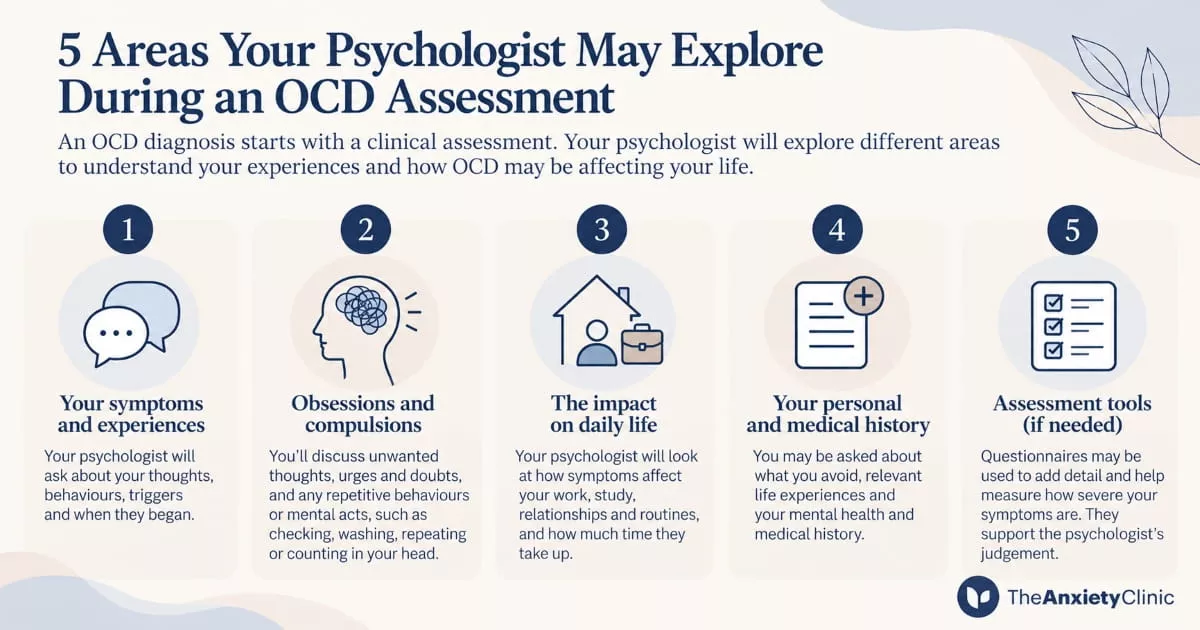
An OCD assessment is often a guided talk. The steps vary between clinicians and people, but it may look like this:
- Current symptoms and when they started
- Obsessions, compulsions, avoidance and reassurance seeking
- How severe symptoms are and how they affect your day-to-day life
- Past mental health support, plus your personal and medical history
- Questionnaires, if your clinician uses them
Tip: Some thoughts feel awkward to say out loud. Share them anyway, because they give your clinician the full picture. Plain words are enough.
A diagnosis can sometimes take time. Some clinicians use a set list of questions. Others keep the talk more open.
Still choosing a clinician? It helps to know how to find the right psychologist in Bondi Junction.
Can You Diagnose OCD Yourself?
Online quizzes and symptom checklists:
- can’t confirm OCD
- can help you spot patterns to mention to a professional
- prove nothing on their own, whether the result is high or low
A quiz can’t tell OCD apart from the conditions it overlaps with. A doctor or psychologist can. Some compulsions are subtle or happen only in your mind, so they’re easy to miss.
If you keep wondering, “do I have OCD?” jot down what you notice and bring it to your appointment. Your clinician can ask follow-up questions, so a professional assessment gives a clearer answer than any checklist.
When Should You Speak to a Psychologist About Possible OCD?

It may be time to speak to a psychologist if:
- intrusive thoughts upset you again and again
- rituals feel hard to control
- you often check things or ask others for reassurance
- you avoid places, people or tasks because of your thoughts
- symptoms get in the way of work, study, relationships or routines
The benefits of seeing a psychologist include a safe, non-judgemental space to talk through what’s going on. A psychologist can explain appropriate treatment for managing OCD.
At The Anxiety Clinic, you also get practical tools for outside sessions. One option is cognitive behaviour therapy with exposure and response prevention.
Family members often want to help. Parents of children and teens can get support too. The International OCD Foundation explains how to support a family member with OCD.
Frequently Asked Questions
Can a psychologist diagnose OCD?
Yes. Psychologists in Australia can diagnose psychological disorders, based on their training and skills. Not every psychologist works with OCD, so ask about experience before you book. At The Anxiety Clinic, our admin team can match you with the clinician best suited to your needs.
Is there a blood test for OCD?
No. Neither a blood test nor any other single test can diagnose OCD. Clinicians look at your thoughts, behaviours, distress and daily life, and they check for other explanations.
Can OCD be mistaken for anxiety?
Yes, it can. OCD often involves significant anxiety and can overlap with anxiety disorders and other conditions. A careful assessment helps OCD get correctly diagnosed rather than confused with similar symptoms.
How long does an OCD assessment take?
It varies from person to person. Your symptoms, your history and whether more evaluation is needed all affect the length, and a diagnosis can sometimes take time. Your clinician can explain what to expect at the start.
Get Clarity About Your OCD Symptoms With Professional Support
Working out OCD alone can be confusing. It overlaps with other conditions, and some symptoms are hard to spot.
If you want a psychologist in Bondi Junction, The Anxiety Clinic offers OCD therapy and support. Our clinical and registered psychologists provide evidence-based care.
You can see us in our light-filled Bondi Junction rooms or by telehealth where suitable. With a Mental Health Care Plan, you may be eligible for Medicare rebates. Our admin team can help match you with the right clinician.
If you’re asking “how is OCD diagnosed?” because intrusive thoughts, compulsions or doubts are getting in the way of your daily life, book an appointment today.